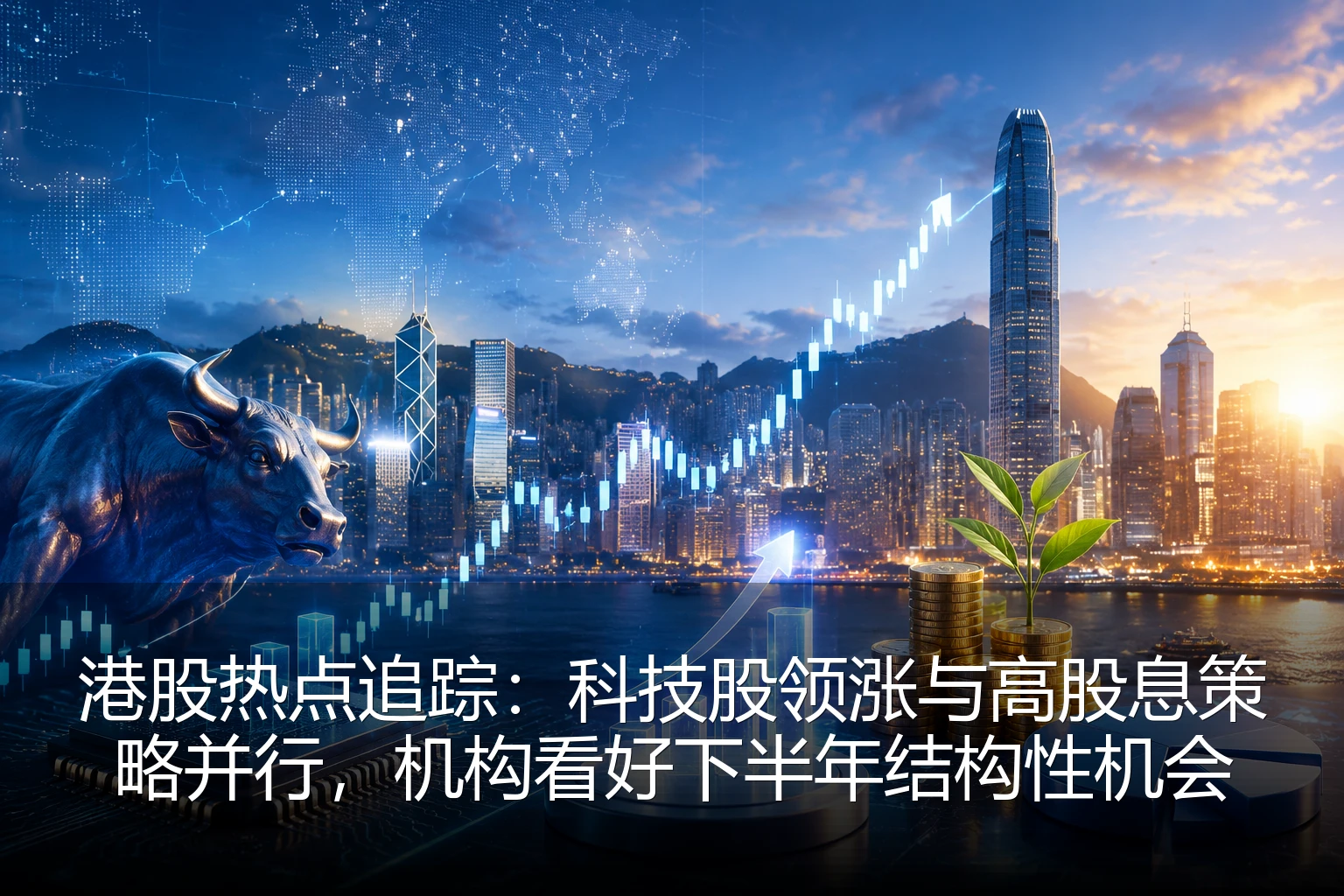
HK Stock Hotspot Tracking: Tech Stocks Lead Alongside High Dividend Strategy; Institutions Optimistic About Structural Opportunities in H2
On August 14, 2026, the Hong Kong stock market exhibited an upward trend with volatility, as the Hang Seng Index repeatedly traded around the 26,000 mark. The market showed clear structural differentiation, with technology stocks and high-dividend sectors emerging as the main drivers, while traditional financial sectors remained relatively weak. Southbound capital continued to flow in net, indicating increasing confidence from mainland investors in the Hong Kong stock market. Multiple institutions released research reports pointing out that amidst increasing global economic uncertainty, the Hong Kong stock market will present distinct structural opportunities in the second half of the year, requiring investors to capture the dual themes of technological innovation and high dividends.Tech Stocks Lead Strongly, AI Concepts Continue to Heat Up
The technology sector has been the absolute protagonist in the recent Hong Kong market, with artificial intelligence-related concepts showing particular brilliance. Leading AI enterprises, represented by MINIMAX-W and SenseTime, have seen sustained stock price increases. MINIMAX-W's cumulative gain exceeded 30% in the past month, with its market capitalization surpassing HKD 200 billion. Market analysts point out that as the commercialization process of global AI technology accelerates, AI industry chain companies in Hong Kong are undergoing a revaluation opportunity due to their technological advantages and undervalued status. In addition to AI concepts, sub-sectors such as semiconductors, cloud computing, and new energy technology have also been active. SMIC has set a new high in nearly half a year, and institutions predict that the company's performance is expected to continue improving in the second half as global chip demand recovers. In the cloud computing sector, stocks like Kingsoft Cloud and Ali Health have led the gains, reflecting the market's positive outlook on the long-term development of the digital economy. Industry insiders analyze that the strength of tech stocks is mainly driven by three factors: first, the better-than-expected performance of global tech giants has boosted the overall valuation of the technology sector; second, domestic policies continue to support technological innovation, providing more development opportunities for related enterprises; and third, the valuation of Hong Kong tech stocks remains relatively advantageous compared to other global markets, attracting incremental capital allocation.High Dividend Strategy Becomes a Preferred Hedge, Utilities Sector Favored
Amid increasing market volatility, the high-dividend strategy has once again become a safe haven for capital. Utility sectors such as power, water, and gas have shown stable performance, with leading stocks like China Yangtze Power and China Resources Gas setting historical highs. Data shows that the average dividend yield of the utility sector exceeds 5%, far above the market average, making it highly attractive in the current interest rate environment. Besides utilities, traditional high-dividend sectors like telecommunications and banking have also attracted attention. Telecom operators such as China Mobile and China Telecom have dividend yields stable above 4%, and they also benefit from 5G business development, offering significant potential for valuation increases. In the banking sector, state-owned large banks are the preferred choice for stable investors due to their solid fundamentals and high dividend yields. The popularity of the high-dividend strategy reflects investors' pursuit of certainty. Against the backdrop of slowing economic growth and increasing geopolitical uncertainty, companies that can provide stable cash flow are favored. Multiple institutions point out that the high-dividend strategy is expected to be one of the key themes in the Hong Kong stock market in the second half, especially for high-quality enterprises that possess both growth potential and dividend capacity.Southbound Capital Continues Net Inflow, Structural Positioning is Clear
Capital flow data shows that Southbound funds have been continuously net flowing into the Hong Kong stock market recently. As of August 13th, the Stock Connect has achieved net inflows for 12 consecutive trading days, accumulating a net inflow exceeding HKD 50 billion. In terms of capital allocation, a clear structural characteristic is evident: technology stocks and high-dividend sectors have attracted major capital, while traditional cyclical sectors have experienced a degree of capital outflow.
Specifically, internet giants such as Tencent Holdings and Meituan remain key targets for Southbound fund accumulation, while AI concept stocks like MINIMAX-W and SenseTime also received significant increases. In the high-dividend sector, utilities and telecommunication operators such as China Longyan Power and China Mobile have seen continuous net purchases. Changes in capital flows reflect investors' grasp of market hotspots and shifts in risk appetite.
Analysts point out that the continuous inflow of Southbound funds into the Hong Kong stock market is mainly based on three considerations: first, the valuation of the Hong Kong stock market remains relatively advantageous compared to other global markets, especially for technology stocks and high-quality blue chips; second, the attractiveness of RMB assets in global asset allocation has increased; and third, mainland investors have deepened their understanding of the Hong Kong stock market, leading to more rational investment behavior.
Institutions are Optimistic About Structural Opportunities in the Second Half, and a Dual Mainline Strategy is Favored
Multiple domestic and international investment banks have released research reports, maintaining a cautiously optimistic view on the Hong Kong stock market for the second half of the year. International banks such as Goldman Sachs and Morgan Stanley believe that against the backdrop of global economic divergence and monetary policy shifts, the Hong Kong stock market will present clear structural opportunities, with technological innovation and high dividends becoming the two main themes.
CICC's research report points out that the Hong Kong stock market is expected to see a valuation repair in the second half of the year. Technology stocks, especially those in the AI industry chain, will benefit from technological breakthroughs and accelerated commercialization, while the high-dividend sector will provide stable returns in an environment of increasing uncertainty. It is recommended that investors adopt a "Technology + High Dividend" dual-mainline strategy to balance growth and defensiveness.
UBS Wealth Management emphasizes that the structural opportunities in the Hong Kong stock market are mainly reflected in three aspects: first, the valuation enhancement opportunities brought by technological innovation; second, the attractiveness of the high-dividend strategy in a low-interest-rate environment; and third, the value re-evaluation opportunities brought by SOE reform. Investors should allocate assets reasonably across these three directions according to their own risk tolerance.
Investment Strategy Recommendations: Grasping Structural Opportunities and Balancing Risk and Return
Based on current market characteristics and institutional views, investors can consider the following strategies when positioning in the Hong Kong stock market:
- Select Stock Allocation in Technology: Focus on leading enterprises in sub-sectors such as AI, semiconductors, and cloud computing, especially those with leading technology and strong commercialization capabilities. Consider using phased accumulation to control position risk.
- Stable Allocation in High Dividends: Allocate to utilities and telecommunication operators with stable dividend yields and ample cash flow to act as stabilizers for the investment portfolio. Pay close attention to high-quality enterprises that possess both growth potential and dividend capacity.
- Focus on Policy Beneficiary Sectors: Closely track policy trends to seize investment opportunities in sectors benefiting from policies, such as SOE reform and technological innovation. Policy dividends are often a significant catalyst for the Hong Kong stock market.