HK Stocks Rise in Volatile Trading: Hang Seng Index Holds Above 25,600 as 'Pharma King' Leads Market
On August 7, the Hong Kong stock market quickly recovered after a sharp adjustment of nearly 1.5% the previous day, with all three major indices closing higher. At the close, the Hang Seng Index stood at 25,668.03 points, up 137.75 points, or 0.54%; the Hang Seng Tech Index reported 4,585.29 points, up 37.51 points, or 0.78%. In terms of market structure, the three main lines of pharmaceuticals, AI applications, and tech hardware complemented one another, showing a distinct structural market pattern.
Looking back at this week's trend, Hong Kong stocks had been rising for more than a month since July, with the Hang Seng Index once breaking through the 26,000-point mark before wavering under pressure from financial stocks. On August 6, the HSI fell 1.49% to around 25,530 points, sparking concerns that the rebound had ended. But just one trading day later, the market regained traction using interim results and industry trends as its fulcrum, showing that capital did not leave but was rapidly rotating among hotspots and selectively picking opportunities.
Interim Results Drive: WuXi AppTec Surges 7% to Record High
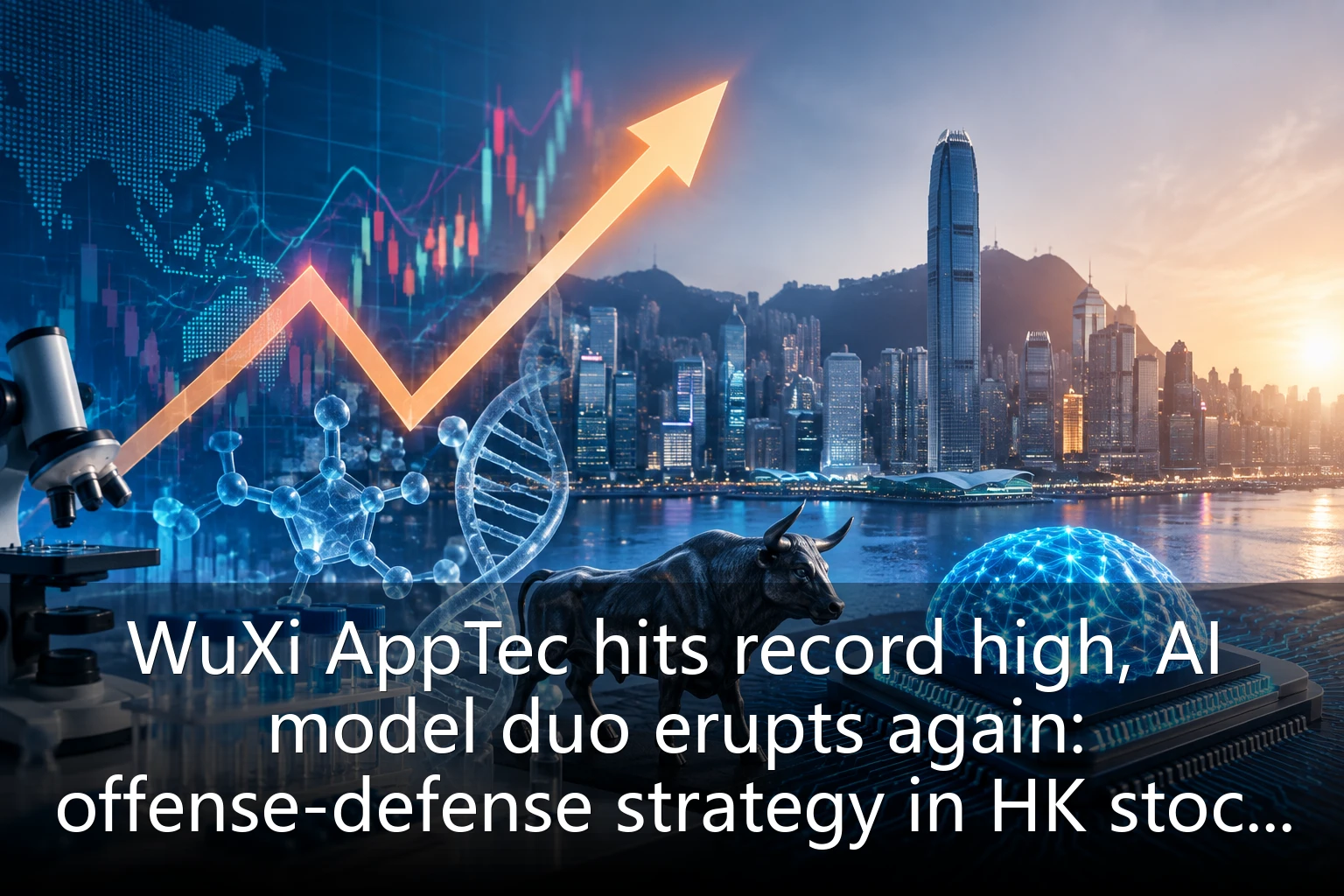
The biggest highlight of the day was WuXi AppTec, known as the "Pharma King." Its share price jumped 7% on heavy volume, hitting an intraday high of HK$193, a record, and pushing its total market value above HK$570 billion. The direct catalyst for the strong share price came from the interim results disclosed this week: the company reported consolidated revenue of RMB 28.9 billion in the reporting period, up 38.9% year-on-year; adjusted net profit attributable to shareholders stood at RMB 11.57 billion, a surge of 83.2% year-on-year; and gross margin rose to 53.2%, up about 9.4 percentage points from the same period last year.
What excited the market even more was that the company raised its full-year guidance, lifting the 2026 total revenue expectation from RMB 51.3-53 billion to RMB 58.5-60.5 billion, and raising the year-on-year growth rate of continuing operations revenue from 18%-22% to 35%-39%. With the CXO industry having endured years of deep adjustment and global biopharma financing still in recovery, the combination of "better-than-expected interim results + guidance upgrade" clearly sent a strong signal that industry prosperity is recovering substantially.
Industry analysts pointed out that WuXi AppTec's surge was not just a valuation repair for a single stock, but reflected capital's extreme pursuit of "earnings certainty." Hong Kong stocks are currently in the peak interim reporting season, and the ability to deliver earnings is becoming the core yardstick for stock differentiation. Leading companies that report better-than-expected results tend to attract concentrated incremental capital, while lackluster performers are easily abandoned. This pricing logic of "heroes are judged by earnings" is a typical feature of a structural market.
AI Dual Main Lines Resonate: Large-Model 'Twin Giants' Erupt Again
Alongside the pharma leader was a collective surge in the AI application track. Zhipu rallied more than 14% that day, while MiniMax rose nearly 10%. Since MiniMax was officially included in the Stock Connect on August 6, its share price has gained nearly 30% in just two trading days, showing the intensity of capital enthusiasm. There is clear news support behind the surge: MiniMax announced on August 3 that its H3 model was officially open-sourced, with domestic chip makers including Moore Threads and Hygon Information completing adaptation simultaneously. Zhipu launched its flagship GLM-5.2 model in June, achieving SOTA results among open-source models on the Artificial Analysis comprehensive leaderboard. The continued validation of commercialization by the two leading large-model companies has significantly boosted market confidence in the "twin giants" and confirmed that the AI industry logic is shifting from "hardware narrative" to "application monetization."
Technology Supply Chain Blossoms, IPO Market Stays Hot
Driven by the AI supply chain, tech hardware and computing power sectors strengthened in tandem: Lenovo Group rose over 8% to a record high, PCB leader Kingboard Laminates gained over 9%, and Stock Connect newcomer Luxshare Precision remained active. The biopharmaceutical sector also performed impressively, with Zai Lab surging over 18% as another highlight. The IPO market stayed hot, as Nasen Technology soared over 64% on its debut, showing that with recovering risk appetite, capital's willingness to support new-economy targets has clearly increased.
Capital-Side Concern: Southbound Capital Sees Net Outflow for Third Consecutive Day
Notably, subtle changes occurred in capital flows behind the index rebound. Data showed that southbound capital recorded net selling of Hong Kong stocks exceeding HK$700 million on August 7, the third consecutive trading day of net outflows. Earlier, southbound capital had returned significantly, with net purchases of HK$27.1 billion in June and HK$62.9 billion in July, driving Hong Kong stocks quickly upward from around 25,000 points. Some institutional investors believe that short-term profit-taking by southbound capital is normal and does not change the medium-term allocation trend. However, with the index approaching the 26,000-point mark, the volatile attitude of capital also signals widening market divergence.
Institutional Perspectives: Rebound or Reversal?
Regarding the nature of this round, major institutions show clearly divergent views, with different emphases in offensive and defensive strategies.
- BOCOM International is relatively optimistic, believing that the HSI and Hang Seng Tech Index bottomed out in July and rebounded, benefiting from liquidity recovery, valuation repair, and earnings improvement. It believes Hong Kong stocks have further upside potential and recommends a "barbell" allocation—with one end in high-elasticity tech growth (internet platforms, AI applications, cloud computing, semiconductors, consumer electronics, and smart vehicle supply chain) and the other in reflation beneficiaries and stable cash-flow assets (energy, materials, and financials).
- GF Securities is more cautious, arguing that within the AI industry cycle, Hong Kong stocks lack pure-play AI hardware targets. Combined with internal competition and capital expenditure pressures in the internet industry, earnings recovery lacks endogenous momentum. Liquidity remains the absolute core driving the market, and the sustainability and room for the third-quarter rebound face considerable constraints.
- Soochow Securities judges that Hong Kong stocks are still in a catch-up rally window, but may face waning upward momentum or pullback risk in the short term. Whether they can strengthen further mainly depends on the pace of overseas liquidity.
- Everbright Securities advises giving up hopes of a broad rally and digging for opportunities in a structural market of "defense as the foundation, growth for returns."
Outlook: Interim Reporting Season and AI Validation Are Key Observation Windows
Judging from the morning session on August 8, the HSI opened slightly lower by 0.01%, while the Hang Seng Tech Index rose 0.26%. Large tech and internet stocks were mixed. Most gold stocks that surged the previous day pulled back, while Zai Lab continued to rally over 10% after its results, showing that the market remains closely engaged with earnings and industry trends.
Overall, the current Hong Kong stock repair rally is jointly driven by three factors: improved liquidity, valuation repair, and upward earnings revisions. In the short term, the index may remain range-bound, but structural opportunities remain abundant. For investors, the realization of interim results, the pace of AI application commercialization, and the direction of southbound capital flows will be three key observation windows for judging the market's next moves. Beneath the lively spectacle of the "Pharma King" hitting new highs and the "twin large-model giants" erupting, maintaining a balanced offense-defense posture and staying focused on the earnings mainline may be the safest approach at present.
(This article is compiled based on public market information and is for reference only. It does not constitute investment advice. The market carries risks; investment requires caution.)