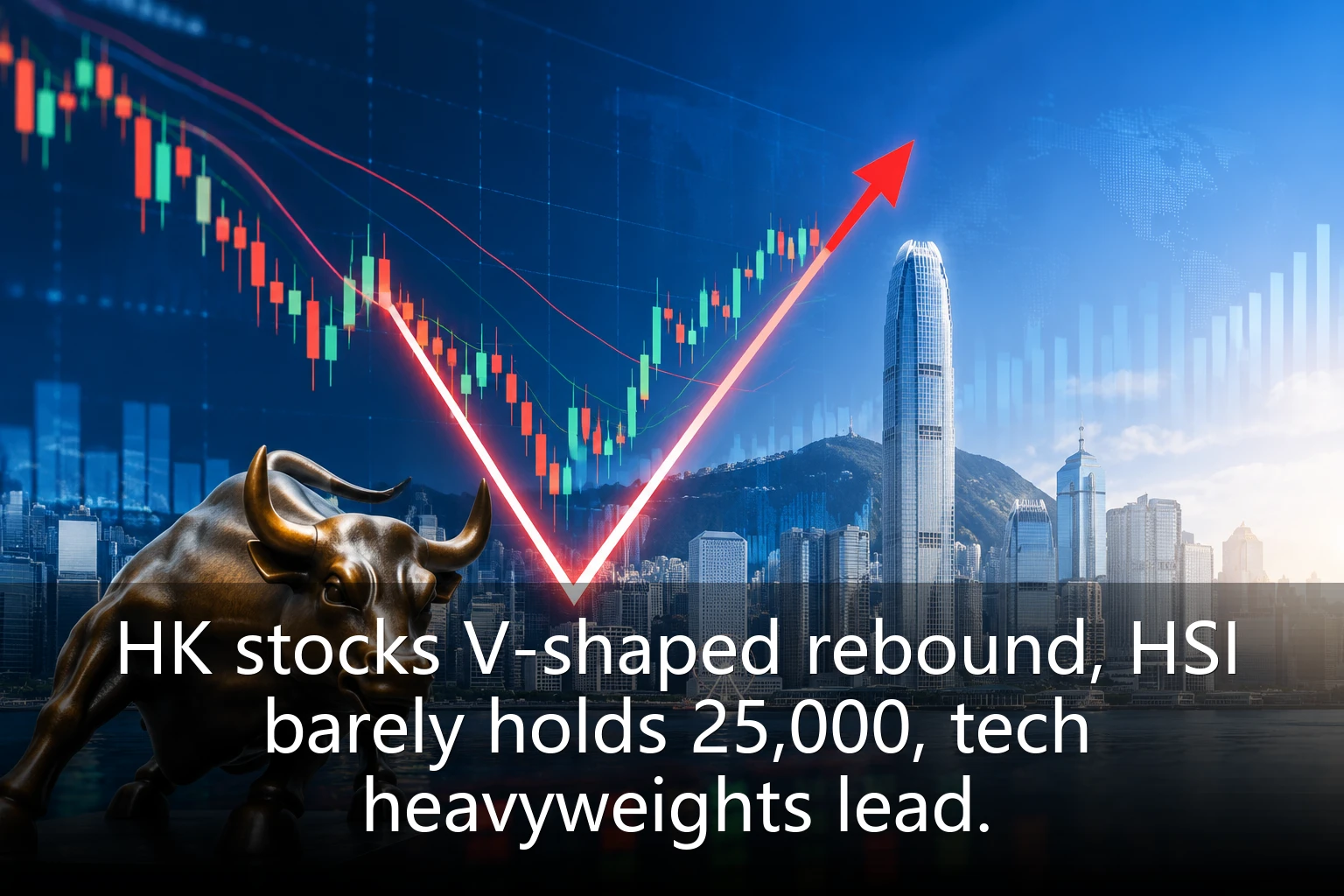
On July 29, 2026, the Hong Kong stock market opened low and fell in the morning; the Hang Seng Index once dipped to around 24,650 points, dropping over 1.5%, with strong risk aversion. However, a dramatic turnaround came in the afternoon, driven by a sharp rally in tech heavyweights and accelerating mainland fund inflows. The HSI quickly recovered, closing at 25,080 points, up 198 points (+0.8%), successfully holding the key 25,000 level. The Hang Seng China Enterprises Index rose 1.1%, and the Hang Seng Tech Index surged 2.3%, leading the three major indices.
Drivers of the V-Shaped Rebound
The market turnaround mainly occurred after 2:30 PM. On the news front, media citing insiders said regulators will soon hold a meeting to discuss measures to further stabilize capital market expectations, including optimizing IPO pace, encouraging share buybacks, and guiding long-term funds into the market. Lifted by this, Hong Kong financial and tech stocks rallied simultaneously. Tencent Holdings (00700.HK) surged from a >1% loss to close +3.2%; Meituan-W (03690.HK) rose 3.5%; Alibaba-SW (09988.HK) rose 2.8%; JD.com-SW (09618.HK) rose 2.6%. The collective strength of large-cap tech stocks became the main engine of the market rebound.
Fund Flow Analysis: Southbound Funds Continue Adding Positions
In terms of fund flow, southbound net buying today was about 45 billion HKD, the second highest in nearly a month, only behind last Friday's 53 billion HKD. By stock, Tencent Holdings, Meituan-W, and CNOOC were the top three net buys. Southbound funds have been net inflows for seven consecutive trading days, with a cumulative total exceeding 200 billion HKD, indicating mainland investors' confidence in HK stocks is gradually recovering. Analysts note that the HSI's P/E ratio is below 10x, at a historically low percentile, and the valuation advantage attracts medium-to-long term capital allocation.
Sector and Stock Performance
Semiconductor and NEV Sectors Lead Gains
By sector, semiconductors led gains; SMIC (00981.HK) rose 4.5%, Hua Hong Semiconductor (01347.HK) rose 5.2%. Reports said the National Integrated Circuit Industry Investment Fund Phase II has recently increased investment in HK-listed semiconductor companies. The NEV sector was also active; Li Auto-W (02015.HK) rose 4%, XPeng-W (09868.HK) rose 3.7%, BYD (01211.HK) rose 1.8%. Online healthcare also surged; JD Health (06618.HK) rose 5%, Alibaba Health (00241.HK) rose 4.2%.
Some Sectors Under Pressure
On the downside, the property sector remained weak; Evergrande (03333.HK) fell 2.5%, Country Garden (02007.HK) fell 1.8%. In the consumer sector, beer stocks pulled back; China Resources Beer (00291.HK) fell 2.2%. Additionally, education stocks that surged yesterday saw profit-taking today; New Oriental-S (09901.HK) fell 3%.
Market Views and Outlook
Regarding today's V-shaped rebound, veteran HK market analyst Li Ming believes the market absorbed negative factors like overnight US stock adjustments and geopolitical uncertainties during the morning decline, while heightened policy expectations in the afternoon triggered bargain hunting. In the short term, the HSI may fluctuate in the 24,500-25,500 range; further upside requires more fundamental catalysts, such as improved macro data or better-than-expected corporate earnings.
CICC's latest research report pointed out that HK stocks' valuations are at historically low levels, but market sentiment recovery takes time. The expected US economic slowdown and domestic economic recovery strength remain key variables affecting HK stock trends. It advises investors to focus on high-dividend, low-valuation, and high-earnings-certainty sectors, such as telecom operators, energy, and utilities.
Risk Warning
Investors should also be aware of risks: the Fed's future rate path remains uncertain, and a stronger dollar may suppress inflows into emerging markets; Hong Kong's local economic recovery may slow, and regulatory policy changes in some sectors could also cause disruptions. In summary, opportunities and risks coexist in HK stocks; maintaining a rational investment mindset, controlling positions, and gradually building positions is the current optimal strategy.
This article does not constitute investment advice. Investing involves risks; enter the market with caution.