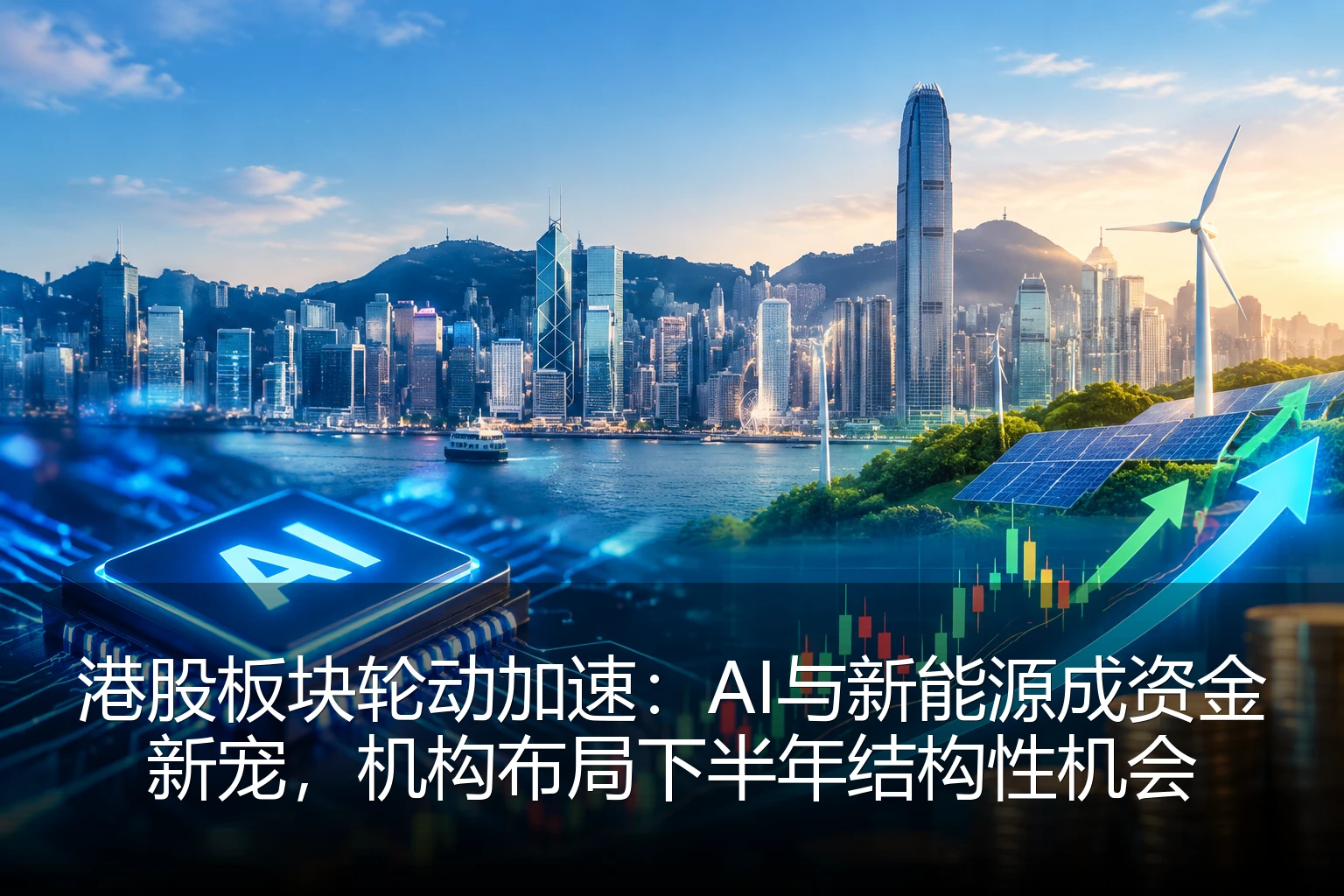
I. Recent Performance of the Hong Kong Stock Market: Clear Sector Rotation Characteristics
Since September 2026, the Hong Kong stock market has generally shown an upward trend with volatility, and the Hang Seng Index has been hovering around 26,000 points. Notably, sector rotation has become a key feature of the market, with growth sectors like AI and New Energy alternating to lead, alongside high-dividend defensive sectors. Southbound capital has seen a cumulative net inflow exceeding 500 billion HKD this year, indicating that AI and New Energy sectors have become favored by capital, while traditional consumption and financial sectors face capital outflow pressure.
1.1 Hang Seng Index Volatility and Increased Sector Differentiation
As of September 20th, the Hang Seng Index closed at 25,876.45 points, up 1.2% from the beginning of the month, but with significant fluctuations during the period. Looking at industry sectors, the Hang Seng Tech Index rose by 3.5%, leading the market; the Hang Seng Energy Index rose by 2.8%; while the Hang Seng Consumer Index fell by 0.5%. This differentiation reflects the market's shift in preference between growth and value, also highlighting the rhythm of sector rotation.
1.2 Southbound Capital Flows: AI and New Energy as Key Focus Areas
Southbound capital, as an important incremental fund in the Hong Kong stock market, significantly influences sector trends. Since September, Southbound capital has seen a net inflow of approximately 30 billion HKD, with the AI sector (such as Tencent, MINIMAX-W, etc.) seeing a net inflow exceeding 15 billion HKD, and the New Energy sector (such as BYD Electronics, CATL, etc.) seeing a net inflow of about 8 billion HKD. In contrast, the financial and real estate sectors face capital outflow, with a net outflow of about 5 billion HKD.
II. The AI Sector: Dual Drive from Policy and Technology, Institutions are Optimistic About the Long-Term Logic
The AI sector is a hot topic in the recent Hong Kong stock market, with its strength primarily driven by the dual impetus of policy support and technological breakthroughs. The national "14th Five-Year Plan" explicitly calls for the development of the artificial intelligence industry, and various localities have introduced supporting policies, providing a favorable development environment for AI enterprises. Concurrently, the commercialization of large model technology is accelerating, such as MINIMAX-W's breakthroughs in intelligent customer service and AI applications, boosting market expectations for profitability.
2.1 Continuous Release of Policy Dividends
In 2026, the national level continues to increase support for the AI industry, including tax incentives, R&D subsidies, and industry funds. For example, Shenzhen and Shanghai have established AI industry funds, focusing on core areas such as AI chips and algorithms. These policies not only reduce corporate R&D costs but also attract more capital, laying a foundation for the long-term development of the AI sector.
2.2 Accelerated Technological Commercialization
The commercial application of large model technology is key to the AI sector's strength. Taking MINIMAX-W as an example, its AI customer service system has been widely used in finance, e-commerce, and other fields, improving corporate operational efficiency. Furthermore, the application of AI in vertical fields such as healthcare and education is gradually being implemented, such as Tencent's AI medical imaging system, bringing new growth points to the AI sector.
2.3 Institutional Investment Logic: Matching Growth Potential and Valuation
Institutional investors' positioning in the AI sector is mainly based on the match between its growth potential and its valuation. Although the current valuation of the AI sector is at a historically high level, institutions believe it still has investment value when considering its potential for performance growth over the next 3-5 years. For instance, a leading fund manager stated that the long-term growth space of the AI sector is vast, and short-term fluctuations do not change the long-term investment logic.
III. New Energy Sector: Policy Support and Global Demand Resonance
The strength of the new energy sector is mainly due to the resonance between policy support and global new energy demand. The domestic "dual carbon" goals are continuously advancing, bringing development opportunities to sub-sectors such as new energy vehicles, photovoltaics, and wind power. At the same time, the growing demand for new energy products in overseas markets like Europe and the United States provides a vast market space for Hong Kong listed new energy enterprises.
3.1 Continued Domestic Policy Reinforcement
In 2026, domestic new energy policies will continue to be active, including subsidies for new energy vehicles and increased photovoltaic installation targets. For example, the National Development and Reform Commission released the "New Energy Vehicle Industry Development Plan (2026-2030)," which sets a target of 50% of new energy vehicle sales by 2030. These policies provide a clear development direction for the new energy sector and enhance market confidence.
3.2 Global Demand Growth Benefits Export-Oriented Companies
Global new energy demand continues to grow, especially in the European market, where the demand for new energy vehicles has significantly increased due to accelerated energy transition. New energy vehicle companies listed in Hong Kong, such as BYD Electronics and Xpeng Motors, have seen significant growth in exports, thanks to their cost advantages and product competitiveness. Data shows that BYD Electronics' exports grew by 40% year-on-year in the first half of 2026, becoming a major driver of its performance growth.
3.3 Institutional Positioning: Focusing on Leading Players in Sub-sectors
Institutions tend to focus on leading enterprises in specific sub-sectors when positioning in the new energy sector. For example, LONGi Green Energy in the photovoltaic field and Li Auto in the new energy vehicle field are key focus areas for institutions due to their technological leadership and high market share. An analyst from a certain brokerage firm stated that leading companies in the new energy sector have advantages in global competition and significant long-term investment value.
IV. Market Logic Behind Sector Rotation: The Game Between Capital and Policy
Sector rotation in the Hong Kong stock market is essentially a game between capital and policy. When policies support a certain sector, capital rapidly flows in, driving the sector up; and when policies shift or capital takes profits, the sector faces adjustment pressure. Furthermore, changes in the global macroeconomic environment, such as the US Federal Reserve's monetary policy and geopolitical risks, also affect sector trends.
4.1 The Signaling Meaning of Capital Flows
The direction of Southbound capital flows is an important indicator of market sentiment. When capital concentrates in a certain sector, it often signals short-term opportunities in that sector; and when capital flows out, risks must be guarded against. For example, the inflow of Southbound capital into the AI and new energy sectors since September reflects institutional optimism about these two sectors, while the outflow from the finance and real estate sectors may foreshadow short-term adjustment pressures in those sectors.
4.2 The Long-Term Impact of Policy Orientation
The impact of policy on sectors is long-term, especially national strategic-level policies such as the "dual carbon" goals and AI development plans, which continuously drive the development of related sectors. Therefore, investors must pay attention to the long-term direction of policies, rather than short-term fluctuations, when positioning sectors.
V. Second Half Investment Strategy: Grasping Structural Opportunities and Balanced Allocation
For investors, the investment strategy in the Hong Kong stock market for the second half should revolve around structural opportunities, focusing on the AI and new energy sectors while also considering high-dividend defensive sectors to achieve balanced allocation.