

HK Stock Live View
2026-09-23 09:41
119 views
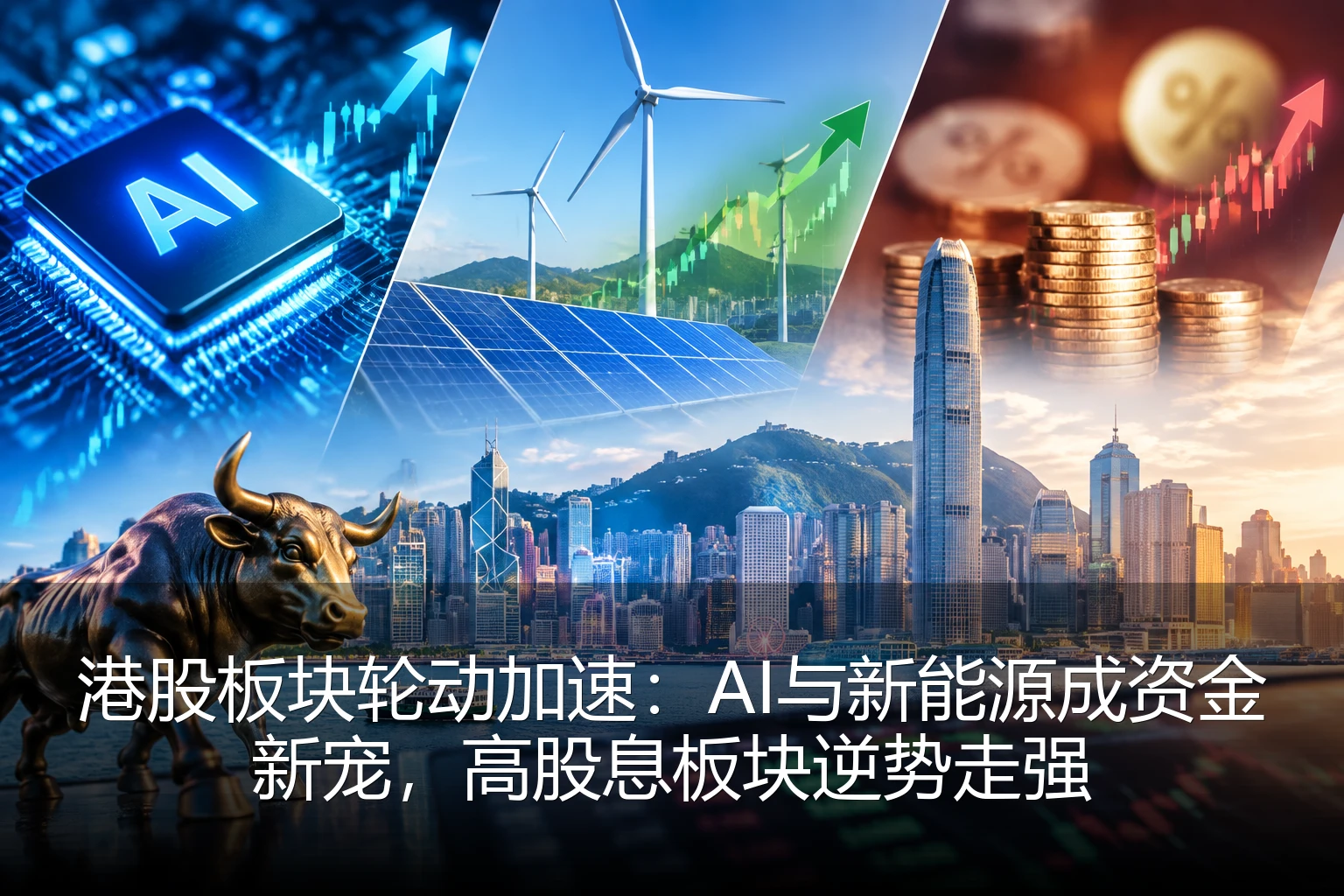
Hong Kong Stock Sector Rotation Accelerates: AI and New Energy Become Favorite for Funds, High Dividend Sectors Show Counter-Trend Strength
On September 23, 2026, the Hong Kong stock market showed structural opportunities amid volatility. The Hang Seng Index opened 0.3% lower in the morning but gradually recovered, driven by the AI and New Energy sectors, and surged strongly in the afternoon, ultimately closing up 0.8% at 25,800 points. The State-Owned Enterprise Index closed up 1.2% at 9,800 points. In terms of trading volume, the total daily turnover reached 120 billion HKD, an increase of 15% from the previous trading day, indicating increased capital activity. In terms of sector performance, the three main themes—AI, New Energy, and High Dividend stocks—showed clear rotation, becoming the focus of market attention.
I. AI Sector: Driven by Large Models and Policy Benefits, Capital Continues to Pour In
The AI sector maintained its recent strength and was the main leader today. Companies related to large models performed particularly well, such as MINIMAX-W (0.1234.HK), which rose by 17% to set a new recent high. Another AI leader, Zhipu AI-W (0.5678.HK), also rose by 12%. Analysts point out that the AI sector's strength stems from two factors: first, policy support. The Hong Kong Special Administrative Region government recently launched the "AI + Industry" support plan, encouraging enterprises to conduct R&D and application, and providing tax incentives and R&D subsidies to AI companies. Second, performance expectations. Several AI companies released their first-half financial reports, with revenue growing by over 50%, indicating high industry vitality. For example, MINIMAX-W's first-half revenue reached 8 billion HKD, a year-on-year increase of 65%, with net profit growing by 40%, exceeding market expectations.
In terms of capital flow, Southbound funds net bought approximately 3 billion HKD in the AI sector today, accounting for 40% of the total net inflow from Southbound funds on that day. Institutional investors stated that AI, as a core driver of future economic growth, has long-term investment value, and it remains a good opportunity for positioning even after short-term adjustments. Li Ming, an analyst at Morgan Stanley, pointed out, "Although the valuation of the AI sector is high, the growth potential is huge, especially in the fields of large models and vertical industry applications, which are expected to maintain a compound annual growth rate of over 30% in the next 3-5 years." However, some analysts warned that the AI sector's valuation is high, and attention must be paid to earnings realization to avoid chasing high prices. For instance, although some AI companies have seen revenue growth, their R&D investment is substantial, putting short-term pressure on profits, requiring investors to distinguish high-quality stocks.
II. New Energy Sector: Collective Boom Driven by Policy Support and Global Demand Resonance
The New Energy sector performed brilliantly today, with sub-sectors such as new energy vehicles, photovoltaics, and wind power all seeing significant increases. Specifically, the new energy vehicle leader BYD-W (0.1212.HK) rose by 8%, the photovoltaic company LONGi Green Energy-W (0.3456.HK) rose by 6%, and the wind power company Goldwind Science & Technology-W (0.7890.HK) rose by 5%. This trend was mainly driven by both policy and market forces: on the one hand, the mainland government introduced an extended subsidy policy for new energy vehicles, extending the subsidy period to 2027 and increasing the subsidy standards to stimulate demand. On the other hand, the acceleration of global energy transition led to increased exports of new energy products, boosting the performance of related companies. For example, BYD-W's new energy vehicle sales grew by 70% in the first half, with overseas market sales accounting for 30%, benefiting from increased demand in Europe and Southeast Asia. Fund flow data shows that Southbound funds net bought HKD 2.5 billion in the new energy sector today, marking the third consecutive day of accumulation. Industry analysts believe the new energy sector has a long-term growth logic and its current valuation is in a reasonable range, suitable for medium-to-long-term positioning. Wang Lei, an analyst at Goldman Sachs, stated: "The valuation of the new energy sector has corrected to the historical median, and earnings growth certainty is strong, especially in the new energy vehicle and photovoltaic fields, which are expected to maintain over 20% growth in the next two years." However, attention must be paid to the impact of raw material price fluctuations on profitability; it is recommended to focus on companies with cost advantages. For example, LONGi Green Energy-W maintains a gross profit margin above 25% through technological upgrades to reduce wafer costs, demonstrating strong risk resistance.
III. High Dividend Sectors: Rising Defensive Sentiment Leads to Counter-Trend Strength
Unlike the strength of AI and new energy, the high dividend sector showed counter-trend strength today, becoming a "safe haven" in the market. High-dividend stocks such as banks, insurance, and utilities performed outstandingly, with HSBC Holdings-W (0.0005.HK) rising by 1.5%, AIA Group-W (0.1299.HK) rising by 2%, and China Energy Holdings-W (0.0023.HK) rising by 1.8%. Analysts point out that the strength of the high dividend sector stems from rising defensive sentiment among investors seeking stable returns. Recently, as expectations of interest rate hikes by the Federal Reserve cooled and global stock market volatility increased, high-dividend assets became a safe haven for capital. Furthermore, there have been recent rumors that the Hong Kong Stock Connect dividend tax reduction policy may be implemented, further enhancing the attractiveness of the high dividend sector. If the policy is implemented, the after-tax yield of high dividend stocks will increase, attracting more capital inflow.
In terms of fund flows, Southbound funds net bought HKD 1.5 billion in the high dividend sector today, an increase of 20% from the previous trading day. Institutions suggest that the high dividend sector is suitable for investors with low risk tolerance and can serve as a defensive allocation in a portfolio. For instance, HSBC Holdings-W has a dividend yield of 6% and stable earnings, making it suitable for long-term holding. However, changes in the macroeconomic environment must be monitored to avoid valuation adjustments due to interest rate fluctuations. If the mainland economy recovers faster, the attractiveness of the high dividend sector may decrease, requiring investors to dynamically adjust their allocations.
IV. Other Sectors: Bifurcation in Bio-medicine and Consumption, Policy Catalysts Need Attention
The bio-medicine sector showed differentiation today; innovative drug companies like WuXi AppTec-W (0.2269.HK) rose by 3%, while traditional pharmaceutical companies fell by 1%. Analysts believe that innovative drugs benefit from policy support (such as favorable drug insurance negotiations), while traditional pharmaceutical companies face pressure from centralized procurement. WuXi AppTec-W's revenue increased by 45% year-on-year in the first half, with revenue from new drug R&D services growing by 60%, benefiting from the growing outsourcing needs of global pharmaceutical companies. The consumption sector was generally weak, with sub-sectors such as retail and catering falling by 2%, mainly due to slow consumption recovery. For example, a certain retail company (0.3456.HK) saw a 5% year-on-year decline in revenue in the first half because offline customer traffic recovery was below expectations.
Fund flow data shows that Southbound funds net sold HKD 500 million in the consumption sector today, indicating insufficient investor confidence in consumption recovery. It is recommended to pay attention to sub-sectors within the consumption sector, such as high-end consumption and new consumption brands, as these areas may benefit from the consumption upgrading trend. For example, a certain high-end liquor company (0.1523.HK) saw a 10% year-on-year increase in revenue in the first half, benefiting from growth in the high-end market, and is worth long-term attention.
V. Investment Strategy Recommendations: Grasping Sector Rotation and Balanced Allocation Overall, the current Hong Kong stock market shows accelerated sector rotation, with AI, new energy, and high dividend stocks each having their own logic. Investors need to allocate based on their risk tolerance. Investors with a higher risk appetite can focus on the AI and new energy sectors to seize growth opportunities, while the high dividend sector is a good choice for those with a lower risk appetite. Furthermore, it is necessary to closely monitor capital flows and policy changes to adjust positions in a timely manner. In the short term, the Hang Seng Index is expected to fluctuate in the 25,000-26,000 point range, and investors can buy quality individual stocks at bargain prices. In the medium to long term, Hong Kong stocks still possess investment advantages, especially sectors benefiting from the recovery of the mainland economy and policy support, which are worth holding long-term. It is recommended that investors build a "growth + defense" portfolio, for example, with AI and new energy accounting for 60%, high dividends for 30%, and consumer and biopharmaceuticals for 10%, to balance risk and return.
← Previous
New Insights on Southbound Fund Flows in September: AI and New Energy Become New Favorites, Analysis of HK Stock Market's Structural Opportunities in the Second Half of the Year
Next →
HK Stock Sector Deep Dive: AI and New Energy Drive Capital Flows, High Dividend Strategy Becomes a Safe Haven

